
Fundoplication is the core of reflux surgery. A wrap is formed from the upper part of the stomach – the fundus – and placed around the lower end of the oesophagus. It works like a valve: food still passes into the stomach, but the backflow of stomach contents is prevented.
How the wrap works
The junction between the oesophagus and the stomach is normally kept closed by the interplay of the lower oesophageal sphincter, the diaphragm and the acute angle between the oesophagus and the stomach. In reflux disease this barrier is weakened, often together with a hiatal hernia.
The operation restores the barrier: first the opening in the diaphragm is narrowed (hiatoplasty), then the wrap is created. It increases the pressure at the entrance to the stomach, lengthens the section of the oesophagus within the abdomen and restores the angle to the stomach.
Toupet fundoplication (270°) – my standard
In the Toupet technique, the wrap encircles the oesophagus from behind by about three quarters (270°); the front remains free. This makes the valve somewhat more “forgiving”: air can escape more easily, and swallowing is usually easier after the operation.
Randomised trials and their meta-analyses show that the Toupet technique controls reflux comparably well to the Nissen technique, but less often leads to persistent difficulty swallowing and bloating. An international guideline from several specialist societies therefore recommends the partial wrap as the preferred option. I use the Toupet technique as my standard.
Nissen fundoplication (360°)
In the Nissen technique, the wrap encircles the oesophagus completely. It is the oldest and longest-studied form of anti-reflux surgery. It prevents reflux very reliably, but more often leads to difficulty swallowing, bloating (“gas bloat”) and an inability to belch or vomit.
I only use it in selected situations, which we discuss in advance.
| Toupet (270°) | Nissen (360°) | |
|---|---|---|
| Wrap | partial, from behind | complete |
| Reflux control | good, comparable | good |
| Difficulty swallowing after surgery | less common | more common |
| Bloating, inability to belch | less common | more common |
| My approach | Standard | Exception |
LINX and RefluxStop: why I do not offer them
Besides fundoplication, there are two implant-based procedures that I am often asked about. I deliberately offer neither of them.
LINX (magnetic ring)
A ring of small magnetic beads is placed around the lower end of the oesophagus. It controls reflux well, and belching and vomiting usually remain possible. However, in a review of more than 4,600 patients, 18% had difficulty swallowing, 13% needed dilatation of the oesophagus, and in 4% the ring had to be removed again. In 1% it migrated into the wall of the oesophagus (erosion) – more frequently the longer it remained in place. For a benign condition, I consider a permanent implant around the oesophagus justified only if it is clearly superior to a well-performed wrap. This has not been demonstrated. In addition, in September 2025 the manufacturer announced that it would withdraw the magnetic ring from the market outside the USA; it is therefore no longer available in Europe.
RefluxStop
A small implant is attached to the outside of the stomach and holds the entrance to the stomach in its correct position; the oesophagus is not encircled. The principle is interesting and the first results are good: in a study of 50 patients, acid exposure of the oesophagus fell markedly for up to five years after surgery, and difficulty swallowing was rare. In a European analysis of 602 patients, serious complications or a repeat operation occurred in 2% after an average of two years. However, there is as yet no randomised trial comparing it with fundoplication, and systematic long-term data beyond five years are lacking.
My conclusion: Toupet fundoplication has been studied in randomised trials over many years, controls reflux reliably and requires no foreign body. Until it has been shown that LINX or RefluxStop perform better, I will stay with the better-studied method. If you are interested in one of these procedures, I will be happy to discuss the arguments for and against openly with you.
Hiatoplasty: closing the gap in the diaphragm
In almost all reflux operations, the opening through which the oesophagus passes through the diaphragm (hiatus) is widened. I narrow it with sutures behind the oesophagus. In very large hiatal hernias I can additionally reinforce the suture with a mesh. Whether a mesh prevents recurrence in the long term has not been conclusively established – which is why I use it selectively rather than routinely (more on hiatal hernia).
Laparoscopic or robotic?
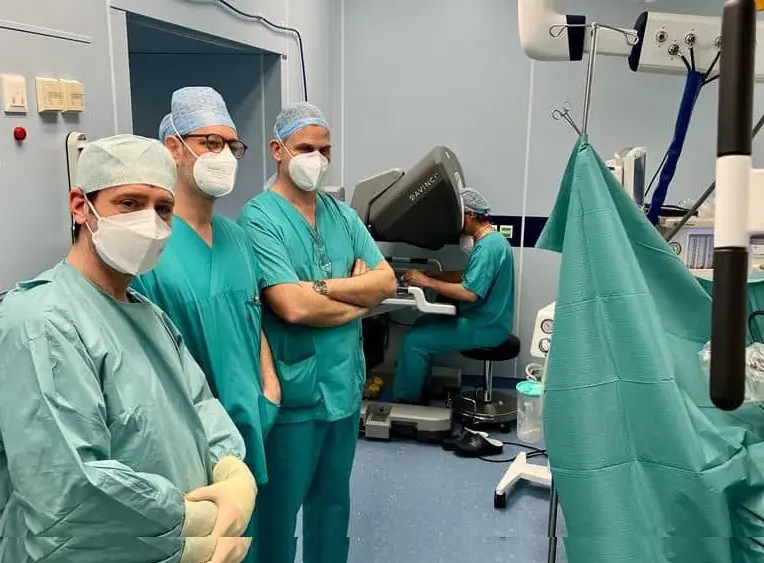
Today, fundoplication is practically always performed using minimally invasive techniques. I operate laparoscopically or with the da Vinci surgical robot, for which I am certified. The robot offers a three-dimensional, magnified view and highly manoeuvrable instruments – especially helpful with large hernias or after previous operations. For the standard operation, the results of both approaches are comparable. However, the technical and time requirements of robotic surgery are considerably greater, without any additional benefit for patients.
What must be clarified before a fundoplication
A wrap may only be created if the oesophagus moves food onwards with sufficient strength. For this reason, in addition to proof of reflux, my preparation always includes video fluoroscopy (barium swallow) and possibly also manometry, which measures the motility of the oesophagus (more on diagnostics).

Medical content by Priv. Doz. Dr. Emanuel Sporn
Specialist in Surgery, Visceral Surgery and Vascular Surgery, former Associate Professor at the Department of Surgery, Vienna University Hospital. More about me
Last medically reviewed:
- Slater BJ et al. Multi-society consensus conference and guideline on the treatment of gastroesophageal reflux disease (GERD). Surg Endosc 2023
- A meta-analysis of long follow-up outcomes of laparoscopic Nissen (total) versus Toupet (270°) fundoplication for gastro-esophageal reflux disease based on randomized controlled trials in adults. BMC Gastroenterol 2016
- Lee Y et al. Long-term outcomes following Dor, Toupet, and Nissen fundoplication: a network meta-analysis of randomized controlled trials. Surg Endosc 2023;37:5052–5064
- Valinoti AC et al. Magnetic sphincter augmentation device for gastroesophageal reflux disease: effective, but postoperative dysphagia and risk of erosion should not be underestimated. A systematic review and meta-analysis. Arq Bras Cir Dig 2024;36:e1781
- Harsányi L et al. Five-year clinical outcomes of RefluxStop surgery in the treatment of acid reflux: a prospective multicenter trial of safety and effectiveness. Surg Endosc 2025
- Schoppmann SF et al. Safety outcomes in 602 GERD patients treated by RefluxStop: a multi-center real-world study from 22 centers across six European countries. Sci Rep 2026;16:18071
- MedTech Dive: J&J exits Linx esophageal reflux business in some countries, 23 September 2025
- S2k-Leitlinie Gastroösophageale Refluxkrankheit und eosinophile Ösophagitis (DGVS, AWMF-Register 021-013), 2023 (German S2k guideline on GERD and eosinophilic oesophagitis)
- Kohn GP et al. Guidelines for the management of hiatal hernia (SAGES). Surg Endosc 2013;27:4409–4428
This page is for information only and does not replace a personal medical examination and consultation.