
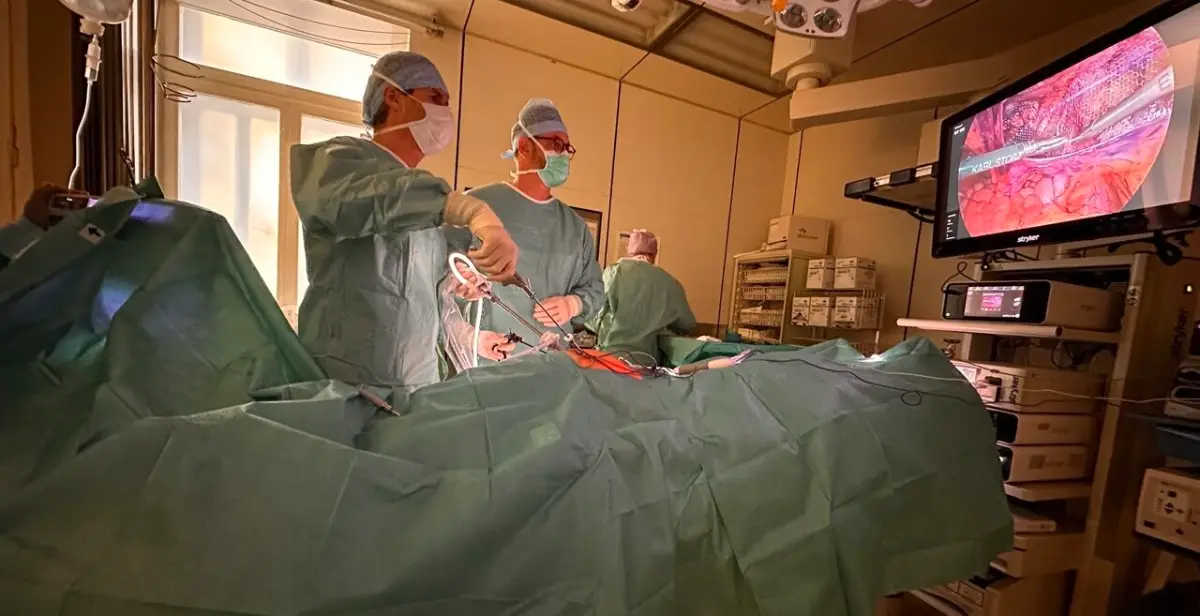
Anti-reflux surgery treats the cause of the backflow: it restores the closure mechanism between the oesophagus and the stomach. Whether it makes sense for you depends on your symptoms, the test results and your personal goals. On this page I explain when I recommend surgery, what the operation involves and what you can realistically expect.
When does surgery make sense?
The basis of every recommendation is a confirmed diagnosis. Typical symptoms alone are not enough – similar symptoms can also have other causes. For this reason, reflux must be objectively proven before surgery, for example by marked inflammation of the oesophagus on gastroscopy or by pH monitoring (more on diagnostics).
Once the diagnosis is confirmed, surgery is mainly considered if
- symptoms persist despite correctly taken medication – especially regurgitation of fluid or food, on which acid suppressants have little effect,
- you respond well to acid suppressants but do not tolerate them or do not wish to take them long term,
- there is a larger hiatal hernia that is itself causing symptoms (more on hiatal hernia),
- complications occur, such as recurrent severe inflammation of the oesophagus.
The best results can be expected when typical symptoms (heartburn, acid regurgitation) are present, reflux has been objectively proven and acid suppressants help at least partially.
Limits of surgery
Surgery is not the right choice for every kind of symptom. I am cautious if
- no abnormal reflux can be demonstrated – for example in the case of an oversensitive oesophagus (functional heartburn),
- only atypical symptoms such as coughing, throat clearing or hoarseness are present,
- there is an oesophageal motility disorder that does not tolerate a wrap (for example achalasia),
- acid suppressants bring no improvement at all – in that case, the cause of the symptoms must be clarified particularly carefully.
Body weight also plays a role: with severe obesity, the risk that the repair will not hold permanently increases. In such cases other procedures may be more appropriate; I will discuss this openly with you.
Surgery or medication?
Proton pump inhibitors (PPIs) are very effective against heartburn and inflammation of the oesophagus. However, they only reduce acid – stomach contents continue to flow back. Surgery corrects the backflow mechanically.
In a large European comparative study (LOTUS), most participants had few symptoms after five years, both on medication and after laparoscopic surgery. After surgery, regurgitation of stomach contents occurred less often; on the other hand, difficulty swallowing, bloating and increased flatulence were more common. Both approaches are therefore good options – which one suits you better depends on your symptoms and priorities.
On long-term use of acid suppressants: numerous side effects have been described in observational studies. For most of them, a causal link has not been proven. Anyone who needs PPIs for a good reason should not stop taking them out of concern, but should agree on the lowest effective dose with their doctor.
What the operation involves
Anti-reflux surgery is performed under general anaesthesia using minimally invasive techniques: a camera and fine instruments are inserted through five small incisions in the upper abdomen – laparoscopically or robotically with the da Vinci system. I decide individually which approach is more favourable for you; for the standard operation, studies show comparable results for both approaches.
- Exposing the junction between the oesophagus and the stomach and returning a hiatal hernia to the abdominal cavity.
- Hiatoplasty: the widened opening in the diaphragm is narrowed with sutures. Only in very large hernias do I additionally reinforce the suture with a mesh.
- Fundoplication: a wrap made from the upper part of the stomach (fundus) is placed around the lower oesophagus. My standard is the partial Toupet wrap (270°); I use the complete Nissen wrap (360°) only in selected cases (more on fundoplication).
The operation usually takes about an hour. Most patients leave hospital the day after surgery.
Risks and possible side effects
Laparoscopic anti-reflux surgery is an established procedure with a low risk of complications. Nevertheless – as with any operation – something unexpected can happen. This includes general risks such as post-operative bleeding, infection or thrombosis, as well as procedure-specific risks:
- injury to the oesophagus, stomach, spleen or nerves, which can usually be repaired immediately,
- air entering the chest cavity (pneumothorax), which usually resolves on its own,
- rarely, conversion to an open abdominal incision.
More common than actual complications are side effects of the new valve function:
- Difficulty swallowing in the first weeks – this is normal and usually resolves within weeks to a few months. Persistent difficulty swallowing is rare and can often be treated by dilatation during a gastroscopy.
- Bloating and a feeling of fullness, because it is harder to belch up air.
- Reduced ability to belch or vomit – less common after the Toupet technique than after Nissen.
Your personal risk depends on pre-existing conditions, previous operations and the size of any hiatal hernia. I will discuss it with you in detail during the pre-operative consultation.
Long-term results and recurrence
With careful patient selection, surgery controls reflux in the vast majority of patients for many years. However, it is no guarantee of a lifetime free of symptoms: in some patients, reflux symptoms return over the years, and some need medication again. A hiatal hernia can also recur – especially after repair of very large hernias. Not every recurrence causes symptoms or needs treatment.
Important: anyone who had Barrett’s oesophagus before surgery will still need regular gastroscopy check-ups afterwards.
Other procedures
Besides fundoplication there are other procedures, such as a magnetic ring around the entrance to the stomach or endoscopic techniques. They are suitable for selected situations and differ in their requirements and the available evidence. With severe obesity, gastric bypass surgery may be the better anti-reflux operation. I explain why I do not offer the magnetic ring (LINX) or RefluxStop on the fundoplication page. I will be happy to discuss with you whether an alternative is an option for you.
Hospital stay and costs
I operate exclusively in Vienna’s private hospitals: the Wiener Privatklinik, the Privatklinik Confraternität – Goldenes Kreuz, the Evangelisches Krankenhaus Wien and the Rudolfinerhaus. With private supplementary health insurance, the costs are usually billed directly to the insurer. Without supplementary insurance, the costs depend on your statutory health insurance, the hospital and the extent of the operation – I will be happy to give you information by phone.

Medical content by Priv. Doz. Dr. Emanuel Sporn
Specialist in Surgery, Visceral Surgery and Vascular Surgery, former Associate Professor at the Department of Surgery, Vienna University Hospital. More about me
Last medically reviewed:
- S2k-Leitlinie Gastroösophageale Refluxkrankheit und eosinophile Ösophagitis (DGVS, AWMF-Register 021-013), 2023 (German S2k guideline on GERD and eosinophilic oesophagitis)
- Slater BJ et al. Multi-society consensus conference and guideline on the treatment of gastroesophageal reflux disease (GERD). Surg Endosc 2023
- Katz PO et al. ACG Clinical Guideline for the Diagnosis and Management of Gastroesophageal Reflux Disease. Am J Gastroenterol 2022;117:27–56
- Galmiche JP et al. Laparoscopic antireflux surgery vs esomeprazole treatment for chronic GERD: the LOTUS randomized clinical trial. JAMA 2011;305:1969–1977
- Targownik LE et al. AGA Clinical Practice Update on De-Prescribing of Proton Pump Inhibitors. Gastroenterology 2022;162:1334–1342
This page is for information only and does not replace a personal medical examination and consultation.