
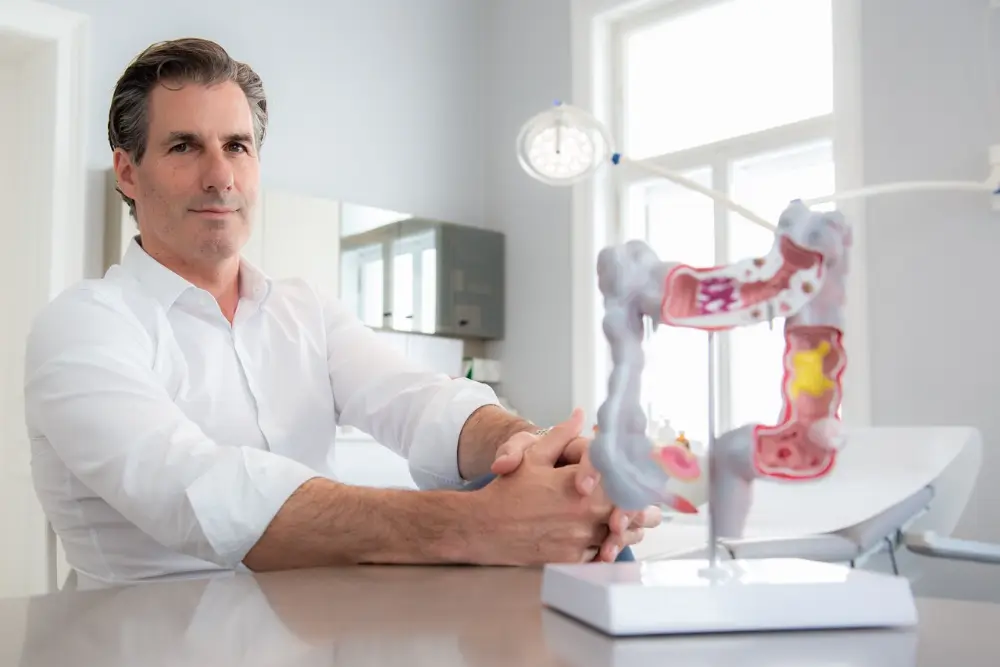
A hiatal hernia (a type of diaphragmatic hernia) occurs when part of the stomach moves up into the chest through the opening in the diaphragm through which the oesophagus passes (hiatus). It is common, becomes more frequent with age and often causes no symptoms. However, it can promote reflux and in rare cases cause serious problems.
Types of hiatal hernia
| Type | What happens | Significance |
|---|---|---|
| Sliding hiatal hernia (axial hernia, type I) | The entrance to the stomach slides upwards into the chest. | Most common type; often without symptoms, but promotes reflux. |
| Paraoesophageal hernia (type II) | The entrance to the stomach stays in place, while part of the stomach pushes up beside it into the chest. | Rare; can cause pressure, pain and a feeling of tightness. |
| Mixed hernia (type III) | A combination of both. | Common in large hernias. |
| Upside-down stomach and type IV | Large parts of the stomach or other organs lie in the chest. | Can twist or become trapped; usually an indication for surgery. |
Symptoms
Small sliding hernias often only become noticeable through reflux symptoms: heartburn and acid regurgitation. Larger hernias can additionally cause:
- a feeling of pressure or fullness behind the breastbone, especially after eating,
- difficulty swallowing or the feeling that food is “getting stuck”,
- shortness of breath after meals,
- anaemia due to small injuries to the lining of the trapped part of the stomach.
Emergency: sudden severe pain in the chest or upper abdomen, retching without being able to vomit, or persistent vomiting may indicate that the stomach has become trapped or twisted. In this case, call the emergency number 144 immediately.
How is a hiatal hernia diagnosed?
A hiatal hernia is usually discovered during a gastroscopy. Its size and position are best assessed with a barium swallow (video fluoroscopy), sometimes supplemented by a CT scan. Before surgery, manometry and pH monitoring are added depending on the situation (more on diagnostics).
When should a hiatal hernia be operated on?
- Sliding hernia with reflux: here, reflux disease is the main issue. Surgery makes sense if the requirements for reflux surgery are met.
- Paraoesophageal hernia with symptoms: guidelines generally recommend surgery.
- Large hernia without symptoms: in older people without symptoms, watchful waiting may also be an option – after careful consideration. The risk of the hernia becoming trapped is low but not zero; we make the decision together.
- Emergency if the stomach becomes trapped or twisted: prompt surgery.
How I operate on a hiatal hernia
The operation is performed using minimally invasive techniques – laparoscopically or robotically with the da Vinci system. I return the stomach to the abdominal cavity, remove the hernia sac and narrow the opening in the diaphragm with sutures (hiatoplasty). To prevent reflux and to fix the stomach in place, I almost always additionally create a Toupet wrap.
Mesh: I only reinforce the closure with a mesh in very large hernias. Meshes can reduce recurrence in the short term; whether this also applies in the long term has not been clearly proven, and they carry their own rare risks. I therefore decide on this case by case.
Can a hiatal hernia come back?
Yes. Especially after repair of large hernias, follow-up examinations not infrequently show a small hernia again. Many of these recurrences cause no symptoms and do not need treatment. If symptoms occur, a repeat operation is possible.
Hiatal hernia and other hernias
A hiatal hernia is one of the hernias. You can find information on inguinal, umbilical and incisional hernias on my website hernien-spezialist.at (in German).

Medical content by Priv. Doz. Dr. Emanuel Sporn
Specialist in Surgery, Visceral Surgery and Vascular Surgery, former Associate Professor at the Department of Surgery, Vienna University Hospital. More about me
Last medically reviewed:
- Kohn GP et al. Guidelines for the management of hiatal hernia (SAGES). Surg Endosc 2013;27:4409–4428
- S2k-Leitlinie Gastroösophageale Refluxkrankheit und eosinophile Ösophagitis (DGVS, AWMF-Register 021-013), 2023 (German S2k guideline on GERD and eosinophilic oesophagitis)
- Slater BJ et al. Multi-society consensus conference and guideline on the treatment of gastroesophageal reflux disease (GERD). Surg Endosc 2023
This page is for information only and does not replace a personal medical examination and consultation.